Relaxation
or Occult?
Yoga
is the "PRAYER" (Communication/Supplication) with a Pagan Deity.
- Yoga
is from the Sankrit word Yug, meaning "union" (with the Divine,
your higher "SELF"). Yoga is a path for transcending the ordinary mind
(who you think you are) in order to merge with your "higher SELF" or "God
SELF." Yoga means "to yoke" -- to yoke with Brahman (i.e., the
"Infinite," the "Universal Spirit," the impersonal force that the Hindus
call "God") via the realization of an altered state of consciousness,
thereby theoretically releasing oneself from the bondage of endless
reincarnation. Yoga comes out of the Hindu Vedas. It can be traced back to
Patanjali, who was a religious leader. Shiva, one of Hinduism's three most
powerful gods, was known as "The Destroyer" -- he's called Yogi Swara or
the "Lord of Yoga."
Consider the following portion of an article
from a secular newspaper:
"It is estimated that there are 10,000 yoga
teachers in the United States, who teach between 4 and 5 million
students a week. Yoga is a program that involves conscious stretching,
deliberate movements, controlled breathing and relaxation exercises. Its
purpose is to develop strength, flexibility, balance, body alignment,
body awareness, muscular balance, calmness and controlled breathing.
Yoga originated from a school of thought in the Hindu religion, which
suggests that postures can isolate the soul from the body and the mind.
"In the Western world, yoga is used mainly as a
form of exercise. Yoga comes from the original Sanskrit word, 'joga,'
which means 'to join.' Yoga means to join body, mind and breath; to get
them to work together in harmony [This is a lie!]. It's very gentle,
slow and meditative; but it requires concentration. Yoga instructors say
they have received a handful of complaints from people who believe yoga
is intertwined with mysticism and the occult. [We] acknowledge that yoga
does indeed come from a portion of India's Hindu religion, but [our]
classes deal mainly with the physical aspects of yoga, and do not in any
way coerce people to become involved in Eastern religion" [another lie].
(Source: The Bloomington Herald-Times, 1991.) (Emphasis added.)
Sadly, even professing Christians have bought
into this lie. Every Yoga teacher is, in effect, a Hindu or Buddhist
missionary, even though "he or she may wear a cross, insist that Jesus was
a great Yogi, and protest that Yoga is not a religion, but science. This
is the most blatant of lies. Yet it has been so widely proclaimed and
believed that in America's public schools, beginning in kindergarten and
in almost every other area of society today, Yoga and other forms of
Hindu-Buddhist occultism are taught and accepted as science. In contrast,
Christianity has been thrown out of the schools and is being crowded out
of every other area of life in the 'broad-minded' move to replace religion
with the New Age 'science'!" (Source: Peace, Prosperity, and the Coming
Holocaust, p. 147.)
Yoga is clearly a
"New Age concept"
that is deeply religious and pantheistic in its origin. It is widely
practiced and supported by New Age proponents. The New Age movement denies
the reality of sin, and believes that man is generally
good and is divine. They teach that there is a god within us, and we are
to harness that and develop it through meditation and other metaphysical
techniques. They teach that the only thing people need is enlightenment
regarding their divinity. They believe that through reincarnation man is
reunited with God. They believe in karma, which is a debt
one owes because of his previous life. They also believe and teach the
evolution of man as opposed to the Creation that is taught in the Bible.
Yoga is also associated with imagery, visualization, hypnosis, mind magic,
chanting of mantra, positive thinking, and Silva mind techniques,
which are not only unbiblical, but are potentially dangerous. When
practiced by professing believers, it allows a certain external spiritual
influence in our lives, which is inconsistent with, and disallowed (2 Cor.
6:14-18), in the teachings of the Holy Scriptures (2 Cor. 4:4).
The practice of Yoga is pagan at best, and
occultic at worse. Its teachings emanate from the Eastern religions, all
of which teach that self is God, only we just don't realize it:
"The goal of Yoga is 'self-realization ' -- to
look deeply within what ought to be the temple of the one true God and
there to discover the alleged 'true Self' or 'higher Self' and declare
self to be God. Nothing could be more religious than that, yet with
straight faces all of the Yogis insist that practicing Yoga will not
change anyone's religious beliefs. This is the religion of Antichrist;
and for the first time in history it is being widely practiced
throughout the Western world as Transcendental Meditation and other
forms of Yoga." (Source: The Seduction of Christianity, p. 54.)
Yoga calls itself science. "By calling
itself science, Yoga (which is the very heart of Hinduism) has
within the last [30] years become an integral part of Western society,
where it is taught in nearly every YMCA or YWCA, in clubs, in public
schools, in industry, and in many churches. Dressed in Western clothes,
Yoga has gained acceptance in medicine, psychology, education, and
religion under such euphemisms as 'centering,' 'relaxation therapy,'
'self-hypnosis,' and 'creative visualization.' Yoga is designed to lead to
the 'realization' of one's true 'godhood' through an inward meditative
journey that finally locates the ultimate source of everything within the
human psyche." (Source: The Seduction of Christianity, p. 110.)
Hatha-Yoga is a popular form of Yoga practiced
today by those looking for a form of relaxation and non-strenuous
exercise. Johanna Michaelsen, however, correctly discerns:
"There is a common misconception in the West
that hatha-yoga, one of about ten forms of Yoga that supposedly leads to
self-realization, is merely a neutral form of exercise, a soothing and
effective alternative for those who abhor jogging and calisthenics ...
[However], Hatha-yoga is 'one of the six recognized systems of orthodox
Hinduism' and is at its roots religious and mystical. It
is also one of the most difficult and potentially [spiritually]
dangerous forms of Yoga.
"The term hatha is derived from the verb
hath, which means 'to oppress.'... What the practice of hatha-yoga
is designed to do is suppress the flow of psychic energies through these
channels ["symbolic, or psychic passages on either side of the spinal
column"], thereby forcing the 'serpent power' or the kundalini
force to rise through the central psychic channel in the spine (the
sushumna) and up through the chakras, the supposed psychic
centers of human personality and power. Westerners mistakenly believe
that one can practice hatha-yoga apart from the philosophical and
religious beliefs that undergird it. This is an absolutely false belief.
... You cannot separate the exercises from the philosophy. ... 'The
movements themselves become a form of meditation.' The continued
practice of the exercises will, whether you ... intend it or not,
eventually influence you toward an Eastern/mystical perspective. That
is what it is meant to do! ... There is, by definition, no such
thing as 'neutral' Yoga" (Like Lambs to the Slaughter, pp.
93-95). (Last emphasis added.)
Other types or brands of Yoga:
(a) Laya Yoga: Path of
Universal Body -- In Laya Yoga, the Macrocosm (the Universe) is directly
networked with the Microcosm (the human body). There are five centres
(chakras, or "wheels") along the spine and one between the eyebrows
that directly corresponds with some aspect of creation. These chakras
are linked through an etheric channel along the spine. A primordial
creative energy (kundalini) lies dormant at the base of the spine
in the root chakra. The Laya Yogi (someone who practices Laya
Yoga), through meditation and Asanas (posture exercises), will
coax this kundalini energy into traveling up the channel through
each chakra until it reaches its point of origin at the top of
the skull. At that point, the yogi will have merged with the source of
creation. If the yogi then chooses to reverse the process, the
kundalini energy will travel back down the channel recharging each
centre with an increased amount of Prana (life force energy). The
result is that the yogi will then have more understanding of, and
control over, all aspects of creation each time this process is done.
(b) Karma Yoga: Path
of Selfless Action -- Action
performed for the purpose of satisfying a desire has the effect of
generating new desires that require additional actions. Addiction to
pleasure (in any form) is a good example of this. Once the desire is
satisfied, it generates more desire, which then needs to be satisfied
ad infinitum. In Karma Yoga, one seeks to end this cycle by not
being attached to the outcome of anything he does. Actions are thus
performed based on what seems appropriate in a given situation. The
person performing the action has no concern about whether the end result
is "good" or "bad." Since the actions are not performed for
self-gratification, the person is free of them. As a result of not being
attached to the outcome, a person can become completely involved in
whatever he is doing. In this way, yogis seek to end the eternal cycle
of death and rebirth.
(c) Jnana Yoga: Path
of Transcendental Knowledge -- This type of yoga is geared toward those
who have an intellectual curiosity, who like to reason and analyze. The
ordinary mind can never know Ultimately and Absolutely. Therefore, the
goal is for the ordinary mind to realize that and, thereby, get out of
the way. In effect, one uses the ordinary mind to transcend the ordinary
mind. Gradually the ordinary mind reveals its true nature to itself. In
the "Who am I?" inquiry, as taught by the great Indian guru Ramana
Maharshi, the mind's false identities are discounted one by one until it
is exhausted. Once the mind has exhausted all its answers, then the
higher Self may emerge.
(d) Bhakti Yoga: Path
of Devotion -- Bhakti Yoga is considered the simplest of the Yogas.
Bhakti is a practice of self-surrender for the purpose of eventually
identifying with the source of love, or the higher Self. It is not
unlike devotion and service associated with religion in the West. The
yogi selects a Saint, Guru, or another figure to direct his devotional
love. Every act in daily life is done to serve the beloved one.
Visualizations and mantras are also part of Bhatki Yoga practice.
The goal is to visualize the beloved one all the time. At first one may
have a picture or representation to look at as the visualization skill
is developed. A sound is repeated at the same time as the visualization.
Although there are many words that can be selected, the sound of "GM"
(A-U-M) is one anyone can use. This practice is especially suitable for
people with intense emotional natures. Key words are: worship, devotion,
self-surrender, visualization, and mantra.
(e) Raja Yoga: Path of
Stillness -- In Raja Yoga, the
goal is to quiet the mind through meditation where the attention is
fixed on an object, mantra, or concept. Whenever the mind
wanders, it is brought back to whatever is the object of concentration.
In time, the mind will cease wandering and become completely still. A
state of focused, uninterrupted concentration will occur. From this
state, the yogi will eventually merge with the higher SELF.
(f) Kriya Yoga
-- Babaji's Kriya Yoga is a scientific art of perfect God Truth union
and Self-Realization. The great Master of India, Babaji Nagarag, revived
it as a synthesis of ancient teachings of the 18 Siddha tradition. Kriya
Yoga claims to bring about an integrated transformation of the
individual in all five planes of existence: physical, vital, mental,
intellectual, and spiritual. It includes a series of 144 techniques or,
"Kriyas," grouped into five phases, or branches.
1. Kriya
Hatha Yoga:
including "Asanas," physical postures of relaxation, "bandahs,"
muscular locks, and "mudras," gestures, all of which bring about
greater health, peace, and the awakening of the principal energy
centres, the "chakras." Babaji has selected a particularly effective
series of 18 postures, which are taught in stages and in pairs. One
cares for the physical body, not for its own sake, but as a vehicle or
temple of the Divine (religious, not just an exercise).
2. Kriya
Kundalini
Pranayama: the "potential" technique, is a powerful breathing
exercise to awaken powerful latent energy and circulate it through the
seven principal chakras between the base of the spine and crown
of the head. It awakens their corresponding psychological states and
makes one a dynamo on all five planes of existence.
3. Kriya
Dhyana Yoga:
meditation, the scientific art of mastering the mind: to cleanse the
subconscious; develop concentration, mental clarity, and vision; to
awaken the intuitive and creative faculties; and bring about the
breathless state of communion with God, "samadhi" (not the God of the
Bible).
4. Kriya
Mantra Yoga:
the mental repetition of subtle sounds to awaken the intuition, the
intellect, and the chakras; the mantra becomes a
substitute for the "I" centred chatter and facilitates the
accumulation of great amounts of energy. The mantra is supposed
to cleanse habitual subconscious tendencies (it is a religious
repetitive chant).
5. Kriya
Bhakti Yoga:
devotional activities and service to awaken pure Divine universal love
and spiritual bliss; it includes chanting and singing, ceremonies,
pilgrimages, and worship.
So if someone's interested in physical
exercises that are designed to help one's body, he should not take
Yoga, which is designed for death, and teaches how to reach this state of
consciousness (see note) where one gets a better reincarnation.
Even the physical positions in Yoga come right out of the Hindu
scriptures, and are designed to put one into this state of consciousness
where you imagine that you're God. Therefore, Christians who think they
think they're getting relaxation and/or exercise, are really getting
Hinduism! They think they're getting science, but they're getting
religion. It's mislabeled and it's dangerous! (Source: a 1988 John
Ankerberg Show program, "The New Age in Society.")
John Weldon and Clifford Wilson wrote in
Occult Shock and Psychic Forces that Yoga is really pure occultism.
Hans-Ulrich Rieker, in his book The Yoga of Light, also warns that
misunderstanding the true nature of Yoga can mean "death or insanity."
Another little known fact is that virtually every major guru in India has
issued warnings similar to these; i.e.,
deep-breathing techniques such
as the ones taught in Yoga are a time-honored method for entering altered
states of consciousness and for developing so-called psychic power.
[Note: Yoga is one of the basic means of reaching this altered state of
consciousness. And the altered state is the doorway to the occult. Sir
John Eccles, Nobel Prize Winner for his research on the brain, said the
brain is "a machine that a ghost can operate." In a normal state of
consciousness, one's own spirit ticks off the neurons in his brain and
operates his body. We are spirits connected with a body. But in an altered
state, reached under drugs, Yoga, hypnosis, etc., this passive but
alert state, the connection between the spirit and the brain, is loosened.
That allows another spirit to interpose itself, to begin to tick off the
neurons in the brain, and create an entire universe of illusion. You've
then opened yourself up. It's called sorcery. People are literally
teaching themselves how to be demonized, all in the name of developing
one's full potential.]
*
Unless otherwise cited, parts of this report have been
excerpted and/or adapted from, Examining & Exposing Cultic & Occultic
Movements, Jack Sin, “Should a Christian Practise Yoga?,” April 2000,
pp. 79-84.
Biblical Discernment Ministries - Revised
1/2002 Yoga and its inherent dangers are
further defined and described as follows:
Once again, just
to briefly reiterate Yoga is
the "PRAYER" (Communication/Supplication) with a Pagan Deity.
Yoga is from the Sankrit word Yug,
meaning 'Union' with the 'Divine', or higher
'SELF'. Yoga is a path for
transcending the ordinary mind as to whom you think you are in order to
merge with your 'higher Self' or 'God Self.' Yoga means 'to yoke' or
more accurately to yoke with Brahman (i.e., the 'Infinite,' the 'Universal
Spirit,' the impersonal force that the Hindus call 'God') through the
realization of an altered state of consciousness, thereby theoretically
releasing oneself from the bondage of endless reincarnation. Yoga
comes from the Hindu Vedas and Patanjali, a Hindu religious leader.
Patanjali, ancient exponent and codifier of classical Yoga formulated
one-hundred and ninety-six Yoga aphorisms (a statement of principles).
Legend
says that Patanjali was an incarnation of Shesha, the 'Kunda' snake of
eternity, and at the end of his life was seen being swallowed by a Python.
Shiva, known as 'The Destroyer', who is also called Yogi Swara, or the
'Lord of Yoga, is one of Hinduism's three most powerful gods.'
There are an estimated 10,000 plus yoga teachers (approx. 15,000,000
practitioners) currently residing within the United States, who teach somewhere
between four to five million students per week. Yoga is a program
that involves conscious stretching, deliberate movements, and controlled
breathing, in conjunction with relaxation exercises. As such, Yoga
originated from a school of thought in the Hindu religion, which suggests
that postures can isolate the soul from the body and the mind.
The practice of Yoga is both pagan and occultic at its best. Its teachings
originate from the Eastern religions, all of which teach that Self
is God, and we only need come to the realization of it. In a book by
Dave Hunt and T. A. McMahon, The Seduction of Christianity, they
state the following:
"The goal of Yoga is 'self-realization' -- to look
deeply within what ought to be the temple of the one true God and
there to discover the alleged 'true Self' or 'higher Self' and
declare self to be God. Nothing could be more religious than
that, yet with straight faces all of the Yogis insist that practicing
Yoga will not change anyone's religious beliefs. This is the
religion of Antichrist; and for the first time in history it is being
widely practiced throughout the Western world as Transcendental
Meditation and other forms of Yoga... Humanity is being
conditioned to accept a coming world ruler who will have the psychic
powers from Satan to 'prove' that he has indeed 'realized' his own
'godhood'"
Yoga calls itself science. "By calling
itself science, Yoga (which is the very heart of Hinduism) has
within the last [30] years become an integral part of Western society,
where it is taught in nearly every YMCA or YWCA, in clubs, in public
schools, in industry, and in many Churches. Dressed in Western
clothes, Yoga has gained acceptance in medicine, psychology,
education, and religion under such euphemisms as 'centering,'
'relaxation therapy,' 'self-hypnosis,' and 'creative visualization.'
Yoga is designed to lead to the 'realization' of one's true 'godhood'
through an inward meditative journey that finally locates the ultimate
source of everything within the human psyche."
The idea of declaring oneself as a god is not a new concept, but merely
a continuation of the lie the serpent in the Garden of Eden sold Eve hook,
line, and apple. "For God doth know that in the day ye eat thereof,
then your eyes shall be opened, and ye shall be as gods, knowing good and
evil." (Genesis 3:5) Sad to say the entire human race is still
paying for that little mistake. We can only speculate as to what
part of
"Don’t Touch It Lest You Die" Adam and Eve could not actually
understand.
Hatha-yoga is an extremely popular form of Yoga practiced today,
especially in the United States, by those looking for a form of relaxation
and non-strenuous exercise. However, we need to take a closer look
at the derivation of the word 'Hatha'. The Sanskrit word 'Ha' means
the Sun while 'Tha' means the Moon. This is a very realistic
symbolic correlation between the possibility of the male/female androgynous aspects of the
'Antichrist and the Beast out of the Abyss,' that will be discussed
in more detail later.
Johanna Michaelsen, in her book, Like Lambs to the Slaughter,
correctly reveals:
"There is a common misconception in the West that
hatha-yoga, one of about ten forms of Yoga that supposedly leads to
self-realization, is merely a neutral form of exercise, a soothing and
effective alternative for those who abhor jogging and calisthenics...
[However], Hatha-yoga is 'one of the six recognized systems of
orthodox Hinduism' and is at its roots religious and
mystical. It is also one of the most difficult and
potentially [spiritually] dangerous forms of Yoga.
The term hatha is derived from the verb
hath, which means 'to oppress'... What the practice of hatha-yoga
is designed to do is suppress the flow of psychic energies through
these channels ["symbolic, or psychic passages on either side of the
spinal column"], thereby forcing the 'serpent power' or the
kundalini force to rise through the central psychic channel in the
spine (the sushumna) and up through the chakras, the
supposed psychic centers of human personality and power. Westerners
mistakenly believe that one can practice hatha-yoga apart from the
philosophical and religious beliefs that undergird it. This is
an absolutely false belief... You cannot separate the exercises
from the philosophy... 'The movements themselves become a form
of meditation.' The continued practice of the exercises will,
whether you... intend it or not, eventually influence you toward
an Eastern/mystical perspective. That is what it is meant to do!...
There is, by definition, no such thing as 'neutral' Yoga" (last
emphasis added.)
In Yoga, Sun Salutations, or Surya Namaskar, can be a complete
practice in and of itself and is often considered the core of 'hatha yoga'
practice. Yoga practitioners such as Hira Ratan Manek (HRM), amongst
others, have allegedly proven that a person can live just on solar energy
for very long periods without eating any food. This has come to be
known as the HRM phenomenon. The method is purportedly used
for curing all kinds of psychosomatic and mental illnesses as well as
increasing memory power and mental strength by using sunlight.
The HRM phenomenon is in fact a rediscovery of a scientific ritual,
which was used to heal physical, mental, emotional and spiritual diseases
in ancient times.
Ancient
Indians called this practice Surya Namaskar, where ancient Egyptians and
Americans called it Heliotherapy and Europeans called it Apollo therapy.
John Weldon and Clifford Wilson wrote in, Occult Shock and Psychic
Forces, that Yoga is pure occultism. Hans-Ulrich Rieker,
an authority on Yoga, in his book, The Yoga of Light, also warns
that misunderstanding the true nature of Yoga can mean
'death
or insanity.'
Another little known fact is that virtually every major guru
in India has issued warnings similar to these; i.e.,
deep-breathing techniques such as the ones taught in Yoga are a
time-honored method for entering altered states of consciousness and for
developing so-called psychic power.
[Note: Yoga is one of the basic means of reaching
this altered state of consciousness. This altered state is the doorway
to the occult. Sir John Eccles, Nobel Prize Winner for his research on
the brain, said the brain is "a machine that a ghost can operate."
In a normal state of consciousness, one's own spirit ticks off the
neurons in his brain and operates his body. We are spirits
connected with a body. In an altered state, reached under drugs,
Yoga, hypnosis, etc., this passive but alert state, the connection
between the spirit and the brain is, loosened. That allows
another spirit to interpose itself, to begin to tick off the neurons
in the brain, and create an entire universe of illusion. You’ve
then opened yourself up. It’s called sorcery. People are
literally teaching themselves how to be demonized, all in the name of
developing one's full potential.]
Controlled breathing can generate intense internal heat
(cf. the Yoga practice of Tapas),
and awaken the Python
(Kundalini Serpent). As stated, this is accomplished
through the Yoga practice known as 'Tapas'. Tapas (austerity):
Literally,
'to burn'; in Yoga, Tapas
implies the burning of all desires by means of discipline, purification,
and penance. Yogis believe this inner fire to be a source of
spiritual energy. It is believed the sole practice of Tapas can lead
to the release of Kundalini and attainment of enlightenment (wisdom).
In Yoga and Mysticism, Swami Prabhavananda warns about the
dangers of the Yoga breathing exercises, which so many today think are
harmless, when he writes:
"Now we come to breathing exercises. Let me
caution you: they can be very dangerous. Unless properly done, there
is a good chance of injuring the brain. And those who practice such
breathing without proper supervision can suffer a disease which no
known science or doctor can cure. It is impossible, even for a medical
person, to diagnose such an illness... [For example,] I had
known a young boy of perhaps 16 or 17 years of age who had begun to
practice hatha yoga... He was acting very strangely. He would
prostrate fully on the ground, rise to full height, then repeat the
performance—over and over again. The Swami said that he had lost his
mind... Finally, however he became so unmanageable that he had
to be confined... As regards breathing exercises, I know that
Sri Ramakrishna, Holy Mother, and all the disciples of Ramakrishna
have warned us again not to practice them."9
Yoga scholar and Sanskrit authority Rammurti Mishra interprets Yoga
theory as laying the foundation for occultism.
"In conclusion, it may be said that behind every
psychic investigation, behind mysticism, occultism, etc., knowingly or
unknowingly, the Yoga system is present."
In his article 'Kundalini and the Occult', occult authority John
White observes that the essence of occultism is the attempt to gain
'higher' knowledge and power or control of the forces of nature,
especially the 'life energy' (prana) which underlies the basis of
true magic and psychic phenomena.
"In its highest form, occult science merges
indistinguishably with true mysticism... [M]ysticism and genuine
occultism are closely allied... The heart of genuine occult practices
appears to be synonymous with aspects of the [yogic] kundalini
concept..."
Yoga authority Sir John Woodroffe (Arthur Avalon), author of a standard
text on Kundalini Yoga, The Serpent Power, refers to Yoga practice
"causing considerable pain, physical disorder and even disease..."
Until his death, perhaps the leading authority on Shamanism and
comparative religion was Mircea Eliade. Note his observations of the
similarities between Yoga and Witchcraft:
"All features associated with European witches are
claimed also by Indo-Tibetan yogis and magicians. Along with a
range of occult powers common to both, some yogis:
...boast that they
break all the religious taboos and social rules: that they practice
human sacrifice, cannibalism, and all manner of orgies, including
incestuous intercourse, and that they eat excrement, nauseating
animals, and devour human corpses. In other words, they proudly claim
all the crimes and horrible ceremonies cited ad nauseam in the
Western European witch trials."
In The Seven Schools of Yoga, Ernest Wood warns of
"the imminent risk of most serious bodily disorder, disease, and even
madness." He observes that many people have brought upon themselves
incurable illnesses or insanity.
Kundalini Serpent Power:
Kundalini is a term from the Yogic tradition for the power of the divine
goddess Shakti. According to Yogic philosophy, Kundalini creates the
universe and knows itself as creator. The Eastern traditions revere
Kundalini as the Great Queen Mother goddess
who gives birth to all that is. Condensing to form, she is viewed as the
material world. She is the essential energy, more fundamental than
all universal power and forms the basis for individual experience and
existence. Yogics believe that the infusion of one’s spiritual mind
with Kundalini power of consciousness is to know truth and their unity
with the Divine. Hindu spiritual tradition and Yogic practitioners
declare
Kundalini synonymous with the Christian
'Holy Spirit'.
(See graphic) In order for seekers to
succeed on their spirit journeys
sham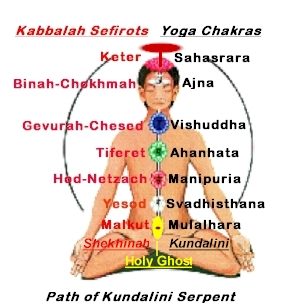 ans,
yogis, monks, priests, nuns, etc., must
all approach her as obedient
suppliants. ans,
yogis, monks, priests, nuns, etc., must
all approach her as obedient
suppliants.
Kundalini is referred to as the
'Power of the Divine' present in
each individual. She has two fundamental expressions. She
maintains the entire existence of the body, mind and spirit, and while
considered dormant, she is the power of consciousness to
know the Divine as
Self. According to her
worshippers, this potential power, allegedly innate to all, can facilitate
its practitioners to unity consciousness, considered the sublime awareness
of Divine Self, infinite and all encompassing. Symbolized by a
sleeping, coiled serpent
wound exactly
three and one-half turns
around the human sacral
bone at the base
of the spine,
Kundalini awaits her
great awakening. She is considered the most exhilarating experience
in the long life of the soul that extends over countless cycles of
physical birth and death, Hindu reincarnation (avatars).
Shaktipat is the Sanskrit term for Kundalini awakening which means
'descent of grace.' Kundalini awakening usually occurs in a specifically
designed ritual for the transmittal of her power. Awakening
Kundalini occurs through various Yogic practices and disciplines, which
have developed over thousands of years, and are specifically structured
for preparing the mind and body for the enormous explosion of power
emanating from Kundalini arousal. Prayer, devotional worship,
chanting, meditation, mantras, ritual dance, drumming and many other pagan
practices can awaken the so-called Divine consciousness - the Kundalini
Serpent. Spontaneous awakening of Kundalini can occur from near
death experiences, traumatic experiences, pain, deep sorrow, prolonged
periods of one-pointed concentration, or even in dreams through the
initiation distributed by an alleged wise being, better known to
Christians as a demon. Kundalini works on all levels of human
experience and touches all aspects of human life. Once awakened, her
victims can never be the same again.
The awakened Kundalini can stir up everything from latent diseases of the
body to emotional or psychological disturbances. Some individuals
feel like fire has descended upon them, rather than grace, as Kundalini
power infuses their body, mind and relationships. As Kundalini moves
through, what Yoga tradition calls the body’s system of channels (nadis)
and the associated seven centers of energy (chakras), its
practitioners willingly succumb to the overwhelming feeling of power.
Kundalini arousal symptoms include, but are limited to the following:
sensations of bodily heat and cold, rushes of energy throughout the body
(especially up and down the spine), sweating, trembling, fear, anxiety,
dissociation, visions, out-of-body experiences, spontaneous body
movements, changes in breathing patterns, mantras, speaking in tongues,
distortions of time and space, healings, habits or addictions falling
away, inspired creativity, feelings of exalted knowledge and wisdom, and
states of boundless ecstasy with love arising for no apparent reason.
Many unsuspecting victims are told during the Kundalini
arousal experience, not to be alarmed that they are being
'Baptized in the Spirit of God'.
Additionally, Kundalini signs are quite often confused with or
misdiagnosed as anxiety disorders, psychotic disorders, dissociation
disorders, chronic fatigue syndrome, fibromyalgia as well as many other
associated diseases. Shifts in values, attitudes, and behaviors will
frequently occur and have a major impact on relationships. However,
when considering the characteristics of Kundalini, one must not overlook
the strong changes in sexual arousal and sexual behavior of many Kundalini
initiates. According to one Kundakini worshiper, "She is the
Power of your own Divinity come to take you home".
Within the minds of both Yoga scholars and practitioners alike, Kundalini
is unquestionably, the
'Queen'.
Let me
make this point perfectly clear to any unsuspecting reader,
"If you
want to anger the one and only true God and make your eternal abode in
HELL, just willingly participate in the practice of Yoga and the pursuit
and arousal of the pagan Kundalini spirit -
raising the serpent power."
In an internet article entitled, The Myth of Manasa --- The Serpent
Queen, by Anjan K. Nath, Ph.D. reveals additional historical
information about the Kundalini Serpent.
"The worship of the snake-energy (often referred to
as the kundalini ) was prevalent amongst the Vedic Aryans and the sect
practicing this form of worship were known as the Sarpas and the Nagas,
and their philosophy of belief known as the Sarpa-Veda. Several seers
of the Sarpa community composed vedic hymns and the esoteric aspect of
this cult was practiced by them even in the usual course of their
rituals. The worship of the Naga or the serpent-power in models
of physical snakes is still prevalent in different parts of India as
in pre-historic times, but more so in Bengal and Assam, where she
is worshiped as a goddess named Manasa.
...The universe is believed to be built up in
spheres and a sphere is called a lotus (padma) or a wheel (chakra).
Siva, with his Rudra aspect, has been honored as a god even in the
Vedas, and when he was identified with the Bindu or nucleus, the
universe was construed to have evolved out of the fall-out of the
emanation from him. This has been explained by saying that
Siva’s sperm was ejaculated on a lotus which in turn percolated
through its stalk and travel[l]ed
to the nether world, i.e., to the lowest end of the universe, and
lodged itself in [a]nother lotus where it was held by a snake-power. It then evolved as Manasa, the Serpent Queen.
...The Manasa cult is one of the most ancient of
the Vedic cults, having as its basis the fundamentals of nuclear
science. The different branches of Indian philosophy are more or
less its off-shoots with the Yoga sect being at the forefront in the
practice and promulgation of the esoteric art of harnessing the
serpent- power, kundalini, towards realization of the philosophic
vision that is necessary for attaining the divine sphere."
Georg Feuerstein, Ph.D, has written more than thirty books including
many popular works on Yoga, notably Tantra: The Path of Ecstasy
(1998), Teachings of Yoga (1997), The Shambhala Encyclopedia of
Yoga (1996), and The Philosophy of Classical Yoga (1980, 1996). His most recent book is The Yoga Tradition (1998). Feuerstein
is a patron of the British Wheel of Yoga, coeditor of Yoga World
newsletter, and a contributing editor of Yoga Journal. For
the past thirty years, Feuerstein has significantly affected the dialogue
between East and West, in particular to the understanding of Yoga.
In a written internet interview between Georg Feuerstein, Ph.D and Richard
Miller Ph.D. entitled, New Light on the Yoga Tradition, Feuerstein
was asked the following question.
"In your book The Yoga Tradition, you
mention learning Hatha-Yoga from an Indian guru while you were
still in your teens. Can you say something more about this?"
Feuerstein responed, "Oh that’s a long time ago.
I spent about a year studying with a Hatha-Yoga master, who was well
known in Europe for his extraordinary yogic abilities, which he was
always eager to demonstrate especially to the medical community... The Hatha-Yoga initiates speak of subtle elements (called tattva),
subtle pathways (called nadi), and psychoenergetic centers
(called cakra). They all must be readied for the visit of
Queen Kundalini, the Goddess energy. Otherwise she gets
angry and ruins your nervous system and organs like the heart. All
this is well known in the Yoga tradition, but many Western
practitioners dabble with it, unaware of the dangers of Kundalini-Yoga."
Gopi Krishna, renowned India author of, Kundalini: the Evolutionary
Energy in Man, presented to the Western world for the first time a
clear and concise autobiographical account of the phenomenon of the
forceful awakening of the Kundalini Serpent. In an extract from his
book,
Krishna reveals Kundalini...
"As the supreme mistress of the body, she and she
alone is considered to be competent to bestow on earnest aspirants
(who worship her with true devotion, centering their thoughts and
actions in her, resigning themselves entirely to her will) the much
coveted and hard to attain boon of transcendental knowledge and
super-normal psychic powers. All these writings assign to
Kundalini the supreme position of being the queen and
architect of the living organism, having the power to mould it,
transform it, or even to destroy it as she will. But how she
manages to do it, consistent with biological laws governing the
organic world, no-one has tried to state in explicit terms."
With regards to this
deceiving power of darkness,
Apostle Paul said it best,
"For we wrestle not against flesh and blood, but against
principalities, against powers, against the rulers of the darkness of this
world, against spiritual wickedness in high places."
(Ephesians 6:12)
In summary, make no mistake,
when you practice Yoga,
or experiment with it, you are well on your way to alienating yourself
from God and entering into a forbidden world of darkness of which few ever
escape.
|

